Smart energy management prevents grid issues in new residential developments
Why grid operators are introducing capacity caps
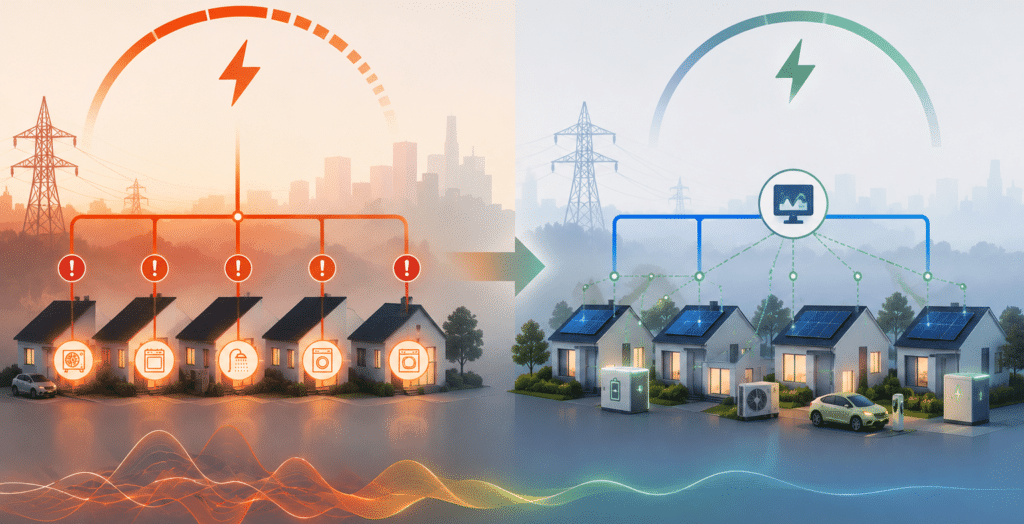
Electricity grids are under increasing pressure. Electric vehicles, heat pumps, home batteries and rooftop solar systems are causing higher peak loads. These peaks occur especially during cold winter evenings and sunny midday periods, leading to local grid congestion.As a result, grid operators advocate for grid-aware new developments. New residential areas must be designed to use available capacity more intelligently. This includes controllable hybrid heat pumps, collective energy systems and dynamic load management.
The underlying principle is shifting: not every household needs a permanently maximum connection capacity when actual demand can be distributed more intelligently.
The traditional grid approach is reaching its limits
For decades, electricity grids were expanded based on a simple principle: growing demand requires more infrastructure.However, this model is under increasing pressure.New substations, medium-voltage networks and cable expansions require long planning cycles, significant investment and complex permitting processes. Meanwhile, electrification is accelerating faster than grid reinforcement can keep up.This creates a new approach: instead of only adding capacity, the focus shifts toward smarter use of existing infrastructure.
A standard 1x25A household connection theoretically provides around 5.75 kilowatts of power. In practice, however, this capacity is rarely used continuously at maximum load. With real-time monitoring and dynamic control, this available capacity can be distributed more efficiently across multiple homes and phases.
This is where energy management systems become essential.
EMS platforms make residential areas more flexible
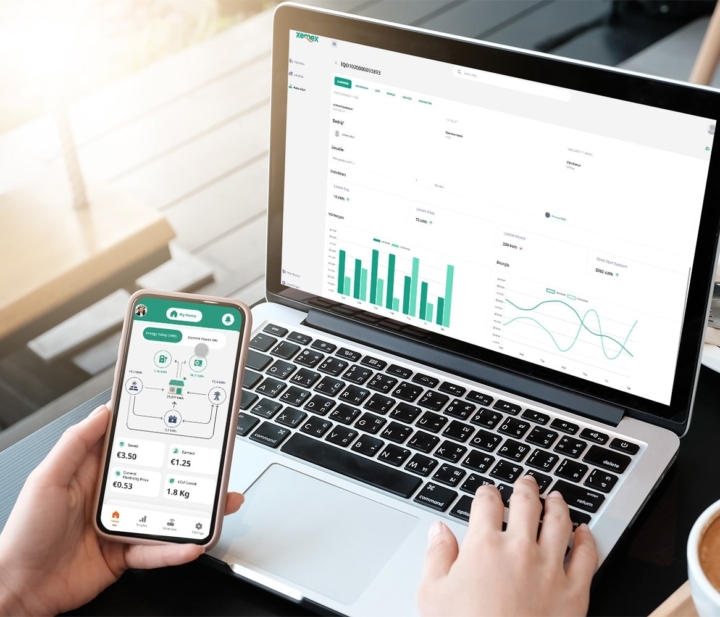
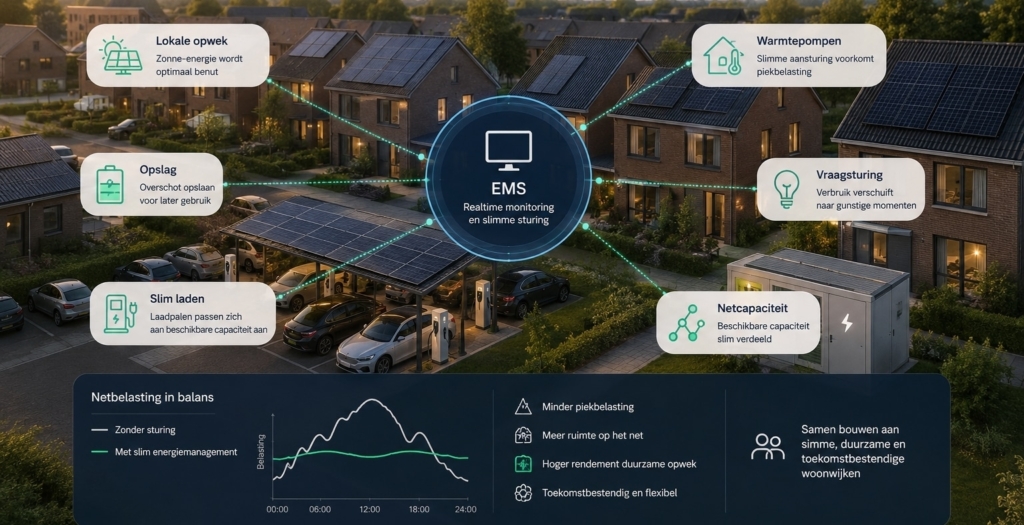
An energy management system continuously monitors energy consumption within a home, building or entire residential district. It analyses real-time data and dynamically controls devices based on available grid capacity.This creates a more flexible energy system where peak loads are actively managed.
For example, in a neighbourhood where multiple homes are charging electric vehicles while heat pumps are running simultaneously, an EMS can temporarily reduce charging speeds or shift energy use to off-peak moments.This prevents severe grid peaks without noticeable loss of comfort for residents.
Phase balancing also plays an important role. Smart monitoring provides insight into how loads are distributed across phases. By dynamically balancing consumption over a three-phase system, neighbourhoods can use the same connection capacity more efficiently.
Transparency is becoming increasingly important
A mandatory capacity cap also raises new questions. Residents want to understand why an EV charger may charge more slowly or why systems behave differently at certain times.That is why transparent monitoring becomes essential.
Users increasingly expect real-time insight into:
- current grid load
- available capacity
- energy consumption per device
- local energy generation
- dynamic control actions within the home
Without this transparency, energy management risks being perceived as limitation rather than optimisation.An open and transparent EMS addresses this by making data understandable and accessible for residents, installers and grid operators alike.
Avoid closed energy systems
The energy market is evolving rapidly. Today, homes may operate with solar panels and EV chargers. Tomorrow, home batteries, vehicle-to-grid systems and local energy hubs will become standard.This makes interoperability a critical factor.
When residential areas depend on closed platforms or proprietary systems, future expansion becomes more difficult and costly. Smart energy management therefore requires flexible software architectures that support different devices and communication protocols.
This open approach aligns better with the future energy system, where devices, homes and energy services are increasingly interconnected.
Collective energy systems reshape new developments
New residential developments are increasingly evolving into local energy ecosystems where generation, storage and consumption are managed together.
This leads to combinations of:
| Component | Role in the neighbourhood |
|---|---|
| EMS platform | Real-time monitoring and energy control |
| Smart charging infrastructure | Dynamic EV charging based on grid capacity |
| Community batteries | Storage and peak load reduction |
| Hybrid heat pumps | Reducing simultaneous peak demand |
| Energy hubs | Smart distribution of available capacity |
As a result, homes are no longer passive consumers but active participants in a flexible energy netwo
Smarter grid utilisation requires balance
The proposal for mandatory grid capacity caps shows that the energy transition is entering a new phase.
While expanding physical grid infrastructure remains necessary, it alone cannot solve capacity challenges. Smart energy management, real-time monitoring and flexible control are becoming the missing link between rising electrification and limited grid capacity.At the same time, this development requires balance. Smart control should not lead to unclear restrictions or closed ecosystems. Transparency, flexibility and open collaboration are essential to ensure future-proof residential developments.
By using existing capacity more intelligently, there is room for continued electrification without overloading the electricity grid.
Always ready to start
Wondering what we can do for your organization? Contact Xemex and discuss your needs with our team. Together we will realize a solution that addresses your energy challenges and opens up new possibilities.
Burgemeester Burgerslaan 40
5245 NH 's-Hertogenbosch, The Netherlands
Metropoolstraat 11a
2900 Schoten; Belgium