The shortest day of the year and our energy use

The winter solstice: an astronomical turning point
The shortest day coincides with an important moment in Earth’s orbit. This moment forms the foundation for everything we experience in winter in terms of daylight and energy.
What happens on December 21?
During the winter solstice, the sun reaches its lowest position in the sky of the northern hemisphere. In the Netherlands, this results in roughly 7.5 to 8 hours of daylight. By comparison, around the summer solstice in June, daylight lasts more than twice as long. After December 21, the days slowly begin to lengthen again, although the change is barely noticeable in the first weeks. Still, this day marks the return of light.
Sun hours in the Netherlands throughout the year
Anyone looking at sun hours in the Netherlands will see a clear seasonal pattern. Not every month contributes equally to solar generation, and this has direct consequences for energy planning.
On average, the Netherlands records around 1,600 to 1,700 sun hours per year. Most of these occur between April and September. During winter, sunlight is scarce but not absent. This distinction between “little” and “none” is crucial for understanding the role of solar energy in winter.
Average sun hours in the Netherlands per month
| Month | Average sun hours |
|---|---|
| January | ± 60 hours |
| February | ± 90 hours |
| March | ± 130 hours |
| April | ± 180 hours |
| May | ± 210 hours |
| June | ± 220 hours |
| July | ± 210 hours |
| August | ± 190 hours |
| September | ± 150 hours |
| October | ± 110 hours |
| November | ± 70 hours |
| December | ± 50 hours |
Solar panels in winter
Solar panels are often associated with long summer days. Yet they also play a role in winter, although in a different way.
Solar output is strongly seasonal. Most of the annual yield is produced in summer. Winter contributes far less, but the value of that production is often higher due to increased electricity prices and higher on-site consumption.
Winter yield versus summer yield
In winter, three factors reduce output: fewer sun hours, a lower sun angle and more cloud cover. Still, on cold and clear days, solar panels can perform surprisingly well. Output may be lower, but it is often used immediately within the home, for lighting, cooking or heating.
Energy consumption around the shortest day
As sunlight fades, energy demand increases. This contrast is most visible around December 21.
Households use more electricity and heat during this period. Morning and evening peaks become more pronounced. This leads to higher costs and additional strain on the electricity grid. Winter clearly shows that energy is not only about generation, but also about timing.
Why energy use increases in December
The combination of short days and low temperatures structurally raises consumption, driven by:
- Longer use of lighting
- Increased heating demand
- More electric cooking and hot water usage
- Higher demand during evening hours
The home battery as a winter solution
Although home batteries are often linked to summer solar storage, their real strength in winter lies in flexibility.
In winter, the focus shifts away from storing large amounts of solar energy and toward making smart use of low-price electricity moments. A home battery allows consumption to move away from expensive peak hours to more favorable times.
What a home battery delivers in winter
A well-controlled home battery helps distribute energy more efficiently throughout the day. This results in:
- Reduced exposure to peak prices
- Smarter use of self-generated solar power
- Lower grid congestion in the evening
- Greater control over energy costs
Dynamic energy prices amplify winter effects
In winter, energy prices react more strongly to weather and demand. Less solar generation and higher demand lead to price peaks, while strong wind conditions can create temporary surpluses.
Those who respond to this dynamic can still save money during the darkest months. Smart control of batteries, charging schedules and heating systems plays a key role.
Heat pumps during cold days
Winter is also the season when heat pumps are used most intensively. This raises questions about efficiency and electricity consumption.
Modern heat pumps are designed to operate at low temperatures, although they consume more electricity in cold conditions. The key lies in steady, continuous heating rather than short, high-intensity bursts.
Smart heating with storage and control
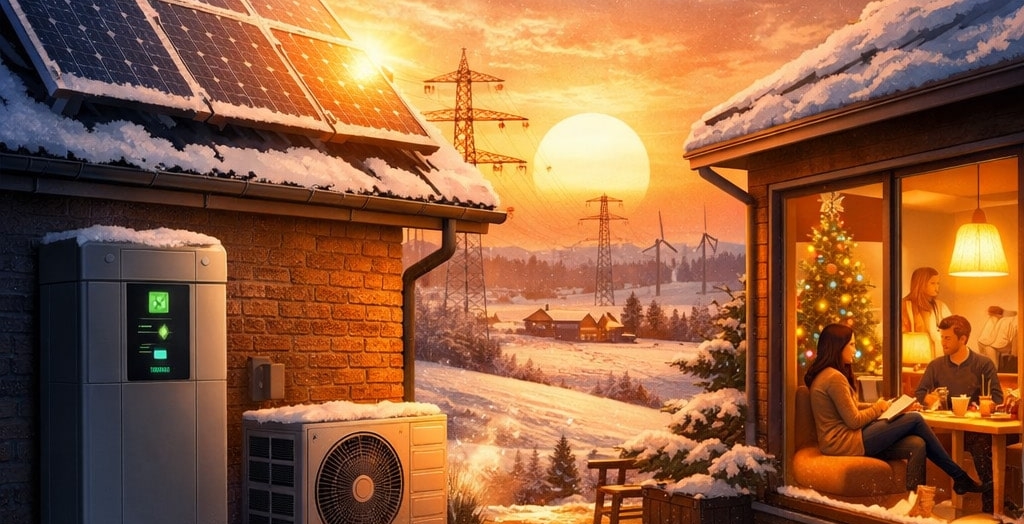
By combining a heat pump with intelligent energy control and, where possible, a home battery, balance is created. Heat is generated when energy is available or inexpensive and retained when demand increases.
The symbolism of the shortest day: From sun hours to smart energy
December 21 does not only represent the minimum amount of daylight, but also progress. From this day onward, daylight slowly returns.The same applies to our energy system. Less dependence on a single source, more focus on insight and flexibility. Winter shows why this shift is necessary.
The shortest day of the year highlights the importance of timing. Sun hours in the Netherlands are limited in winter, but not useless. Solar panels generate less, yet often at valuable moments. Home batteries and heat pumps complement this.
Those who use energy intelligently look beyond generation alone and consider the entire system. Especially on December 21, one thing becomes clear: the future of energy is not about more sunlight, but about smarter use.
Always ready to start
Wondering what we can do for your organization? Contact Xemex and discuss your needs with our team. Together we will realize a solution that addresses your energy challenges and opens up new possibilities.
Burgemeester Burgerslaan 40
5245 NH 's-Hertogenbosch, The Netherlands
Metropoolstraat 11a
2900 Schoten; Belgium