Solving Grid Congestion: Grow Within Your Existing Connection
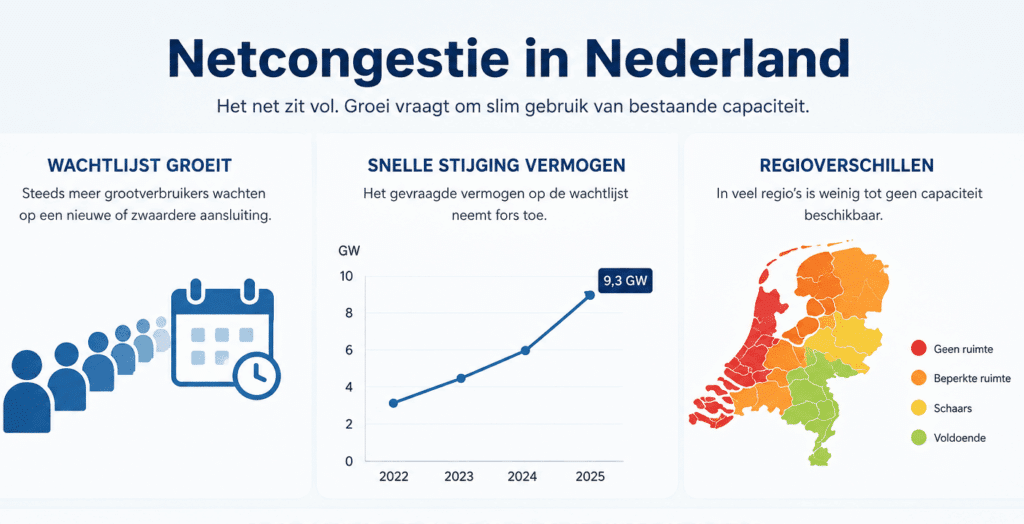
Just how severe grid congestion in the Netherlands has become is clear from the figures. At the end of 2025, according to the third progress report of the National Grid Congestion Action Programme (LAN), 15,014 large-scale consumers were on the waiting list for transport capacity. That’s 26 percent more than a year earlier, together representing roughly 9.3 GW of capacity. From 1 July 2026, the reserved capacity for small consumers will also be phased out. As a result, SMEs in congested areas can end up on a waiting list too, as soon as they apply for a new or heavier connection. Grid congestion is no longer just a problem for heavy industry: it now affects every organisation that wants to grow.
That shifts the question that really matters. Not: when will grid operators expand the network further? But: how much room is actually left in the connection you already have today?
Grid Congestion: A Problem of Peaks, Not a Shortage of Power
Grid congestion occurs when, at a given moment, more electricity needs to flow through part of the network than the infrastructure can handle. That applies both to consumption and to feed-in. The Netherlands doesn’t have too little electricity year-round; supply and demand simply peak at the same moment more and more often. Electric cars charge, heat pumps heat buildings, and factories electrify their processes. Meanwhile, sun and wind supply electricity whenever the weather dictates, not whenever the grid has room for it.
Netbeheer Nederland, the association of Dutch grid operators, points out that the grid isn’t full everywhere, all the time. It’s mainly the peak moments that cause grid congestion; outside those peaks, plenty of capacity is often still available elsewhere. Hence the shift towards making smarter use of what’s already there.
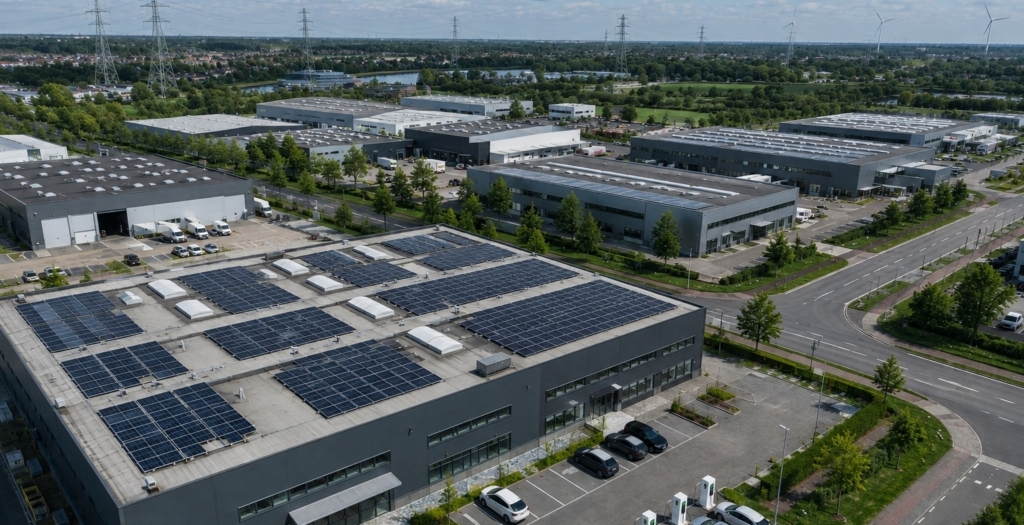
A similar, smaller-scale version of grid congestion often occurs behind a company’s own meter, too. Back to that business park at four o’clock: the connection isn’t structurally too small, it’s just that different installations happen to demand their maximum at the same moment. That single peak then determines how much room is left on paper. An extra charging hub or heat pump then looks impossible without grid reinforcement. But the real question is whether structurally more capacity is genuinely needed, or whether it’s mostly an unfortunate coincidence.
That distinction, between buying more capacity and making smarter use of existing capacity, shows up in situations such as:
- charging points that all draw full power at the same time
- HVAC systems that start up at exactly the same moment
- production processes that independently cause peaks
- solar panels whose output isn’t matched to local consumption
- batteries or flexible assets that you don’t deploy right when the connection is under pressure
When you control all those processes independently, a peak quickly emerges that may only last briefly, but still determines how much capacity a company thinks it needs. That’s precisely why energy management is increasingly becoming part of the solution to grid congestion.
From Energy Consumption to Energy Control
The BNR Zakendoen podcast episode with Fudura CEO Bert Bakker wasn’t titled ‘doing business without an extra power connection’ for nothing — it’s about growing despite grid congestion. Energy is no longer a utility that simply runs in the background. Available connection capacity now partly determines whether an organisation can expand, become more sustainable, or electrify.
Fudura points to Thermo Fisher Scientific in Eindhoven as an example: despite grid congestion, the company kept growing substantially. Its campus doubled in size over ten years. The company absorbed that growth by combining solar panels with energy storage and energy management, without immediately needing extra grid capacity. The starting point: first gain insight into the existing energy profile, then actively steer the available capacity. RVO, the Netherlands Enterprise Agency, likewise advises organisations running up against their limits to first map out their energy profile. From there, you examine which processes — such as charging points, cooling, heat pumps and production — you can control flexibly. An Energy Management System (EMS) then automatically measures, monitors and controls that consumption.
That shifts the question from ‘how much power does my company use?’ to ‘when do I use power, for what, and which processes can wait?’
No Grid Congestion Control Without Insight
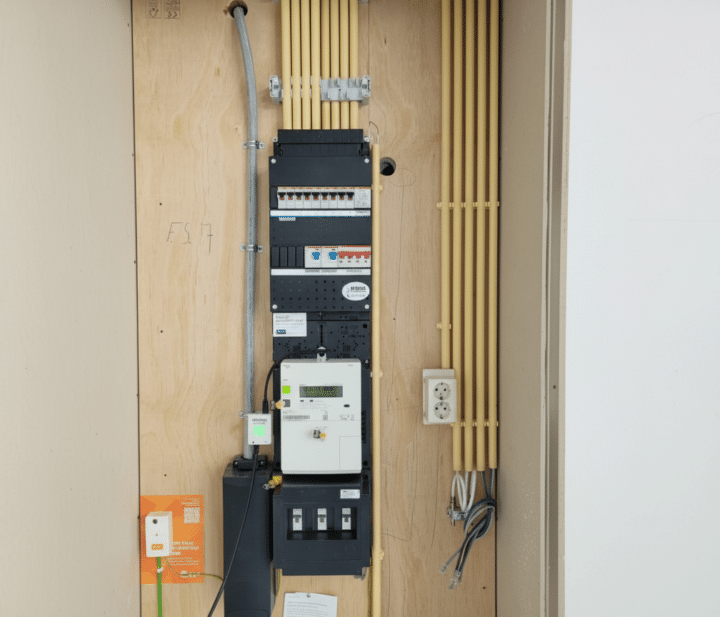
An EMS can only control what it actually sees. Many companies know their total consumption from the energy bill or main meter, but don’t know exactly which installation is responsible for a peak. That’s where submetering comes in. By measuring energy flows separately — with a CompactIQ, for example — you can see what a location’s energy profile actually looks like, and above all, where the simultaneity comes from.
The difference this makes can be summed up as follows:
| Main metering only | Main metering + submetering |
| Total consumption visible | Consumption visible per installation or group |
| Unclear where peaks originate | Peak consumption easy to trace |
| Reactive response to high load | Targeted optimisation possible |
| Limited view of flexibility | Insight into controllable, flexible assets |
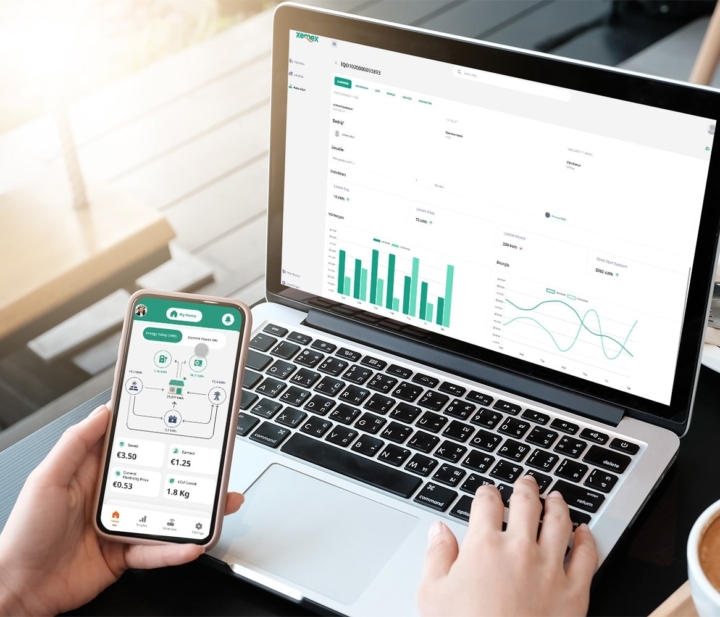
Submetering thus forms the information base an EMS can build on — and with it, the foundation for any approach to grid congestion. CompactIQ tells you what’s happening; an EMS such as ENNY then helps determine what to do about it, which is especially valuable when a company has several energy assets that influence one another.
Peak Shaving: Flattening Peaks to Ease Grid Congestion
Back to that business park at four o’clock. With peak shaving, an EMS prevents total power demand from exceeding a preset limit during such a peak moment. That doesn’t happen by switching processes off, but by cleverly distributing available capacity. As the load approaches the limit, the charging hub temporarily gets slightly less power. As soon as production runs a bit more quietly again, that power automatically returns. A battery can help here too: charging when the load is low, and deploying that energy the moment demand peaks.
Total energy consumption doesn’t necessarily go down as a result. The gain lies in when you use that power. A process that runs a quarter of an hour later ultimately consumes the same number of kilowatt-hours. But because not everything demands its maximum at the same time, the connection stays within its limit. In a system where capacity is scarcer than energy itself, that’s exactly what matters.
Dynamic Load Balancing: Continuously Shifting Capacity
Dynamic load balancing takes this a step further. Instead of allocating fixed amounts of power in advance — say, 100 kW for charging points and 50 kW for HVAC — the system continuously distributes what’s available. That happens based on the current situation and pre-set priorities. If production demands 350 of the available 500 kW at a given moment, 150 kW remains for other uses. If production drops back to 250 kW, extra room immediately opens up, which disappears again as soon as demand rises. A logical order of priorities might look like this:
- critical production processes always get priority
- building-related installations get power within set limits
- charging infrastructure uses whatever is still available
- flexible assets temporarily scale back as the connection limit approaches
In this way, the existing connection stops being a fixed limitation and becomes a capacity you actively manage. That’s also exactly the direction RVO and Netbeheer Nederland are pushing when it comes to tackling grid congestion: more emphasis on flexibility and spreading out consumption, alongside physical grid expansion.
Tackling Grid Congestion: Measure First, Expand Later
Staying realistic matters here: an EMS doesn’t create extra transport capacity on the grid, so it doesn’t fully solve grid congestion. If a company structurally needs more power than is technically available, grid reinforcement remains necessary. But many organisations still don’t know exactly how much capacity they truly need on a structural basis, and that’s precisely where the biggest opportunity lies. By first mapping the energy profile and analysing peaks, it often turns out that growth is possible without immediately applying for a heavier connection. Think of spreading energy-intensive processes over time, dynamically controlling charging infrastructure, making better use of locally generated energy, deploying battery storage strategically, or automatically managing priorities between assets.
The Dutch government likewise explicitly advises companies to first investigate whether a heavier connection is really necessary before joining the grid congestion waiting list. A logical starting point is therefore simple: first map out what’s actually happening behind the existing connection. How high are the peaks, how often do they occur, and which installations cause them? Which processes are flexible, and how much room opens up when you distribute consumption more smartly? Only once those questions are answered does it become clear whether grid reinforcement is truly the only route.
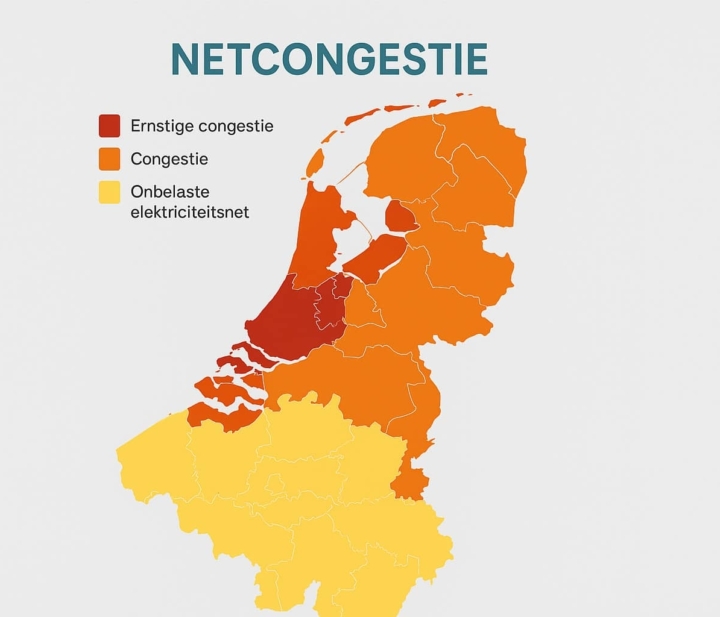
It also pays to look beyond your own meter. The national capacity map on Partners in Energie shows in which regions grid congestion is most severe, and where transport capacity is still available. The same expansion can be straightforward at one location, while a few kilometres away it might mean years of waiting. Grid congestion has thus become just as much a location-based issue as a technical one.
Solving Grid Congestion Doesn’t Always Start With a Heavier Connection
Expanding the grid remains essential: the Netherlands is investing heavily in new cables and transformer stations. But that expansion takes time, and companies can’t wait indefinitely for a solution to grid congestion. Increasingly, the answer lies in doing two things at once: expanding the grid and making smarter use of existing capacity. For organisations, the latter starts within their own connection.
With CompactIQ, you gain detailed insight into where you’re using energy and power. An EMS such as ENNY then translates that insight into active control. Peak shaving and dynamic load balancing bring flexible consumers into better alignment with one another, not by restricting consumption, but by distributing available capacity more intelligently.
The waiting lists caused by grid congestion make clear that companies can’t always count on swift grid reinforcement. But a full waiting list doesn’t mean growth has to stall. Mostly, it’s peaks and coincidental simultaneity that limit connections, not a structural shortage. By gaining insight into what happens behind the meter and actively controlling flexible power, room for new applications opens up within existing capacity. An EMS doesn’t solve grid congestion across the Netherlands. But it does solve the local problem that matters to a business: how do you get more out of the connection you already have today? Now that extra grid capacity is becoming less and less of a given, managing grid congestion intelligently is becoming an ever more valuable starting point.
Sources
- Dutch Government – LAN Progress Report, Spring 2026
- Dutch Government – Approach to Power Grid Waiting Lists
- RVO – Options for Businesses Facing Grid Congestion
- RVO – Managing Energy Consumption During Grid Congestion
- Netbeheer Nederland – Flexible Use of the Power Grid
- Netbeheer Nederland – How Congestion Management Works
- ACM – Flexible Electricity Consumption
- Partners in Energie – Capacity Information and Congestion
- BNR Zakendoen – Bert Bakker on Doing Business Without an Extra Power Connection
- Fudura – What Does a Chief of Energy Actually Do?
Frequently Asked Questions About Grid Congestion
What is grid congestion?
Grid congestion occurs when the power grid doesn’t have enough capacity at certain moments to transport all the electricity being requested or fed in. As a result, new connections, expansions and sustainability projects can face delays.
What does grid congestion mean for businesses?
Businesses may face waiting times when they need a new or heavier electricity connection. This can affect expansion, electrification, charging infrastructure, heat pumps and production processes.
Can a business grow without a heavier connection?
In some situations, yes. When the existing connection is mainly limited by short-lived peaks, smart energy management can help spread energy use more evenly over time and make more efficient use of available capacity.
How does an EMS help with grid congestion?
An Energy Management System doesn’t solve grid congestion on the public power grid. It can, however, measure, monitor and control energy consumption, allowing businesses to reduce peak loads and gain more control over the capacity within their existing connection.
What is peak shaving?
Peak shaving means flattening peaks in electricity consumption. An EMS can temporarily scale back flexible consumers or deploy energy storage to prevent the maximum connection capacity from being exceeded.
What is dynamic load balancing?
Dynamic load balancing dynamically distributes the available power across different energy consumers. It can take into account the current load and pre-set priorities.
Why is submetering important?
Submetering provides insight into the energy use of individual installations, groups or processes. This makes it visible where peak consumption arises and which energy consumers could potentially be controlled flexibly.
Where can I check whether my region is affected by grid congestion?
The current situation per region can be viewed via the national capacity map from Partners in Energie, and with your regional grid operator.
Want to know more? Ask us!
Do you have a question about our products or solutions? Then please contact us. Together we will look for the best solution for your energy problem.
Burgemeester Burgerslaan 40
5245 NH 's-Hertogenbosch, The Netherlands
Metropoolstraat 11a
2900 Schoten; Belgium