Smart metering is the foundation of fair energy allocation.
For property owners and facility managers, this creates a clear challenge. They need transparent billing, reliable consumption data and a future ready metering infrastructure that supports emerging energy models. At the same time, tenants expect greater insight into their own energy consumption and a fair distribution of energy costs. Without an intelligent metering infrastructure, this often leads to uncertainty, inefficient administrative processes and ongoing discussions about energy allocation.
This is exactly why the demand for submetering continues to grow. Not as a standalone metering solution, but as an integral part of modern energy management.
From Consumption Registration to Active Energy Allocation
For many years, submetering was primarily used for cost allocation. Individual submeters recorded energy consumption, after which energy costs were divided based on periodic meter readings. Today’s energy market, however, requires much more.
Buildings increasingly rely on dynamic electricity tariffs, on site solar generation, battery storage, shared EV charging infrastructure and must cope with grid capacity constraints. As a result, energy management is no longer limited to recording historical consumption. Instead, it requires real time visibility and active energy management.
This calls for a metering architecture that not only collects data but also makes it instantly available for applications such as supply split, secondary allocation and the development of local energy hubs. At the same time, emerging market developments such as MLOEA increasingly support building based allocation models, where accurate metering data forms the foundation for fair energy distribution and intelligent energy optimisation.
Why Traditional Submeters Are No Longer Sufficient
Many existing buildings use individual submeters to provide occupants with insight into their own energy consumption. While this may appear to be a practical solution, it often results in a fragmented metering infrastructure.
Meter data is scattered across multiple devices, system integrations are missing and data collection is performed manually or through multiple software platforms. As a result, there is no central overview. Once local renewable generation, battery storage or shared energy assets are introduced, it becomes increasingly difficult to allocate energy flows transparently.
For both commercial and municipal submetering applications, centralised data collection is essential. Facility managers require a single reliable data stream. Property owners need scalability. Tenants expect transparent and verifiable energy allocation.
This is where an intelligent gateway architecture provides significant added value.
CompactIQ as an Intelligent Gateway for Submetering
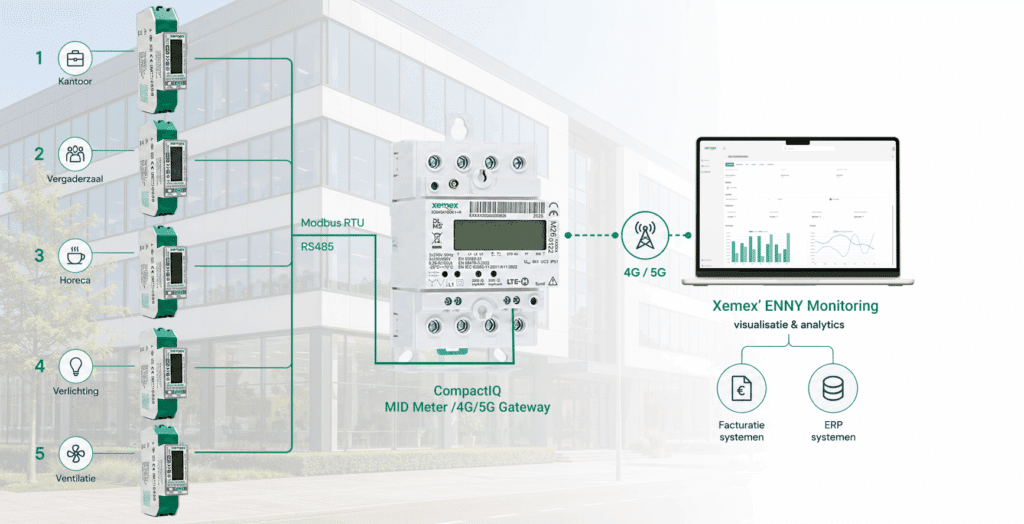
With CompactIQ, Xemex offers a compact solution designed specifically for modern submetering environments. The strength of CompactIQ lies in the combination of highly accurate metering and intelligent gateway functionality.
The system reads multiple Modbus energy meters, centrally collects all measurement data and immediately converts it into a uniform data stream that can be used for monitoring, energy allocation and energy optimisation. This creates a scalable metering layer that perfectly fits multi tenant buildings where multiple apartments, commercial units or shared installations operate behind a single utility connection.
Instead of managing a collection of individual meters, CompactIQ creates one intelligent metering network in which all energy flows are brought together. This makes it possible to monitor individual energy consumption in real time, distribute locally generated energy fairly and automatically apply allocation rules,
Supply Split and Secondary Allocation in Practice
For many multi tenant buildings, supply split is becoming increasingly important. Available energy, for example from a central photovoltaic installation, can be distributed among multiple users based on predefined allocation rules or real time consumption data.
This is followed by secondary allocation, where the assigned energy is further distributed among individual apartments, technical installations or usage zones. This approach is becoming increasingly relevant in buildings where collective renewable generation and shared energy facilities are combined.
CompactIQ provides the data layer that makes these processes possible. By centrally connecting every metering point, the system delivers the accuracy required for reliable energy allocation. This makes CompactIQ suitable not only for existing commercial submetering projects, but also for future applications within local energy communities.
The Rise of Energy Communities and Local Energy Hubs
Buildings are increasingly evolving into independent energy ecosystems. They generate renewable energy locally, store surplus energy and intelligently distribute available capacity among connected users. This forms the foundation for energy communities and local energy hubs.
To ensure these models operate reliably, transparent metering data is essential. Every energy flow must be measurable. Every allocation must remain transparent and verifiable.
CompactIQ supports this transition by bringing all energy data together within one scalable platform. This not only provides complete visibility for building managers but also creates the foundation for integration with external energy markets and future allocation models.
Within these environments, integration with the Enny EMS platform delivers even greater value. By directly linking measurement data to intelligent energy management, the system evolves from simply recording energy flows to actively optimising them.
Ready for Future Regulations and New Market Models
The energy market continues to evolve towards more flexible allocation mechanisms and local energy sharing. Concepts such as MLOEA demonstrate that building level metering infrastructure will play an increasingly important role in the years ahead.
For property owners and facility managers, this means investments in metering infrastructure must not only meet today’s requirements but also be prepared for future developments.
CompactIQ delivers exactly that certainty. Thanks to its open interfaces, high metering accuracy and scalable integration capabilities, the system supports both current submetering applications and future expansions towards intelligent energy communities and advanced energy allocation models.
Smart Submetering as the Foundation for Modern Building Management
The energy transition is placing new demands on buildings. Transparency, flexibility and real time insight are becoming the new standard. For multi tenant buildings, this requires a metering solution that goes beyond traditional submeters.
CompactIQ provides a compact and intelligent metering layer that transforms energy consumption data into fair allocation, active energy management and future proof building control. As a result, it forms the foundation for commercial and municipal submetering, local energy hubs and new energy models in which intelligent energy sharing takes centre stage.
For property owners, building managers and tenants, this delivers one key advantage: complete control over energy today and in the future.
Frequently Asked Questions about Submetering in Multi Tenant Buildings
What is submetering?
Submetering is the process of measuring the energy consumption of individual users within a single building or behind one utility connection. This may include apartments, offices, retail units or commercial spaces. By measuring each user separately, building owners and facility managers gain the accurate data needed for fair billing, real-time monitoring and more efficient energy management.
Why is submetering important for multi tenant buildings?
Modern buildings increasingly include shared solar installations, battery storage, EV charging infrastructure and other distributed energy resources. As a result, a single utility meter is no longer sufficient to accurately allocate energy consumption. Submetering provides transparent energy allocation, reliable consumption data and a future-ready metering infrastructure that benefits building owners, facility managers and tenants alike.
What is the difference between a utility meter and a submeter?
A utility meter measures the total energy consumption of a building for the grid operator and energy supplier. A submeter measures the consumption of individual apartments, commercial units or technical installations. Together, these measurements provide complete visibility into energy flows throughout the building.
What is supply split?
Supply split is the process of distributing locally generated energy, for example from a shared photovoltaic (PV) system, among multiple users within a building. The allocation can be based on predefined business rules or real-time energy consumption, ensuring that locally generated electricity is shared fairly and efficiently.
What is secondary allocation?
Secondary allocation is the next step after supply split, where the allocated energy is further distributed to individual apartments, commercial units or technical installations. This enables transparent, accurate and auditable energy allocation throughout the building.
How does CompactIQ support submetering?
CompactIQ reads data from multiple Modbus energy meters, centralises all measurement data and converts it into a single, standardised data stream. This allows building managers to monitor energy consumption in real time, allocate energy costs fairly and use the data for reporting, energy management systems and future smart energy services.
Can CompactIQ be integrated with an Energy Management System (EMS)?
Yes. CompactIQ integrates seamlessly with Enny EMS and other energy management platforms. This enables measurement data to be used not only for monitoring and billing, but also for intelligent energy optimisation, load management and advanced energy control strategies.
Is CompactIQ suitable for energy communities and local energy hubs?
Absolutely. By providing accurate, centralised metering data, CompactIQ creates the foundation for local energy hubs, energy communities and future energy sharing models. It supports both today’s commercial submetering applications and tomorrow’s decentralised energy ecosystems.
Place a Request for Compact Metering in Multi Tenant Buildings
Are you looking for a compact metering solution for your EV charging plaza, car park or energy hub? CompactIQ combines energy metering and gateway functionality in a single compact format — suitable for load balancing, EMS integration, billing and solar charging without additional hardware in the cabinet.
Fill in the form and receive a no-obligation proposal based on your situation. Our specialists are happy to assess which configuration best fits your charging infrastructure, connection type and energy management requirements.
Burgemeester Burgerslaan 40
5245 NH ’s-Hertogenbosch, Nederland
Metropoolstraat 11a
2900 Schoten; België

"*" indicates required fields