Compact Gross Production Metering in PV Installations: The Smart Foundation for Subsidy Settlement and Energy Management
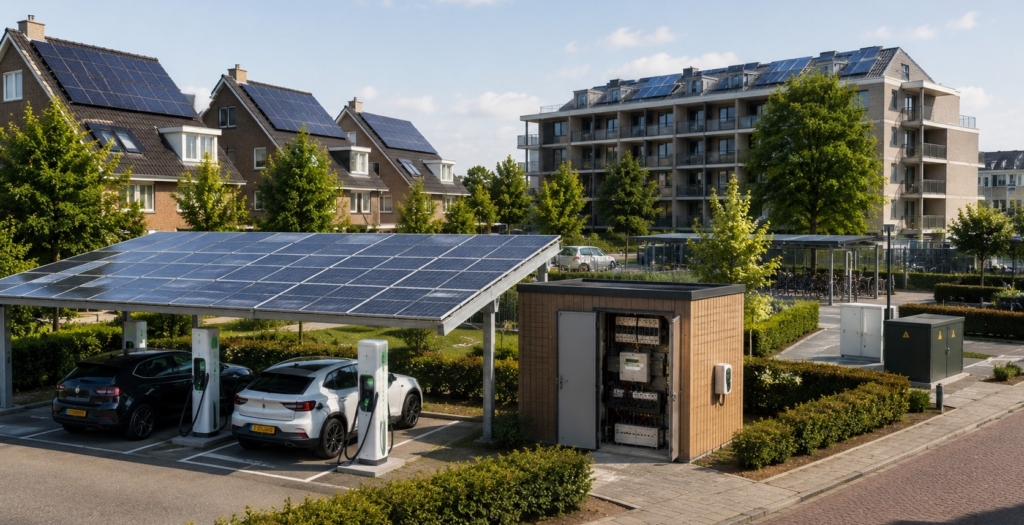
For large commercial PV projects using the SDE++, accurate gross production metering is an essential condition for subsidy payment. The Netherlands Enterprise Agency (RVO) requires that generated energy be demonstrably and verifiably recorded via a certified gross production meter. On high-volume connections (> 3×80 A), this metering is typically handled by separate sub-meters per production installation. The communication challenge lies not in the metering itself, but in consolidating and exposing all that sub-meter data to the metering company, backend or energy management system — without requiring additional cabinet expansion.
For small commercial PV installations (up to 3×80 A), a different question arises. With the disappearance of the net-metering scheme in 2027, the priority shifts from feed-in to maximum self-consumption. Small commercial customers are therefore increasingly investing in battery storage and energy management systems. To allow these systems to operate optimally, reliable production data is indispensable — not so much for subsidy obligations, but as input for EMS algorithms that maximise self-consumption.
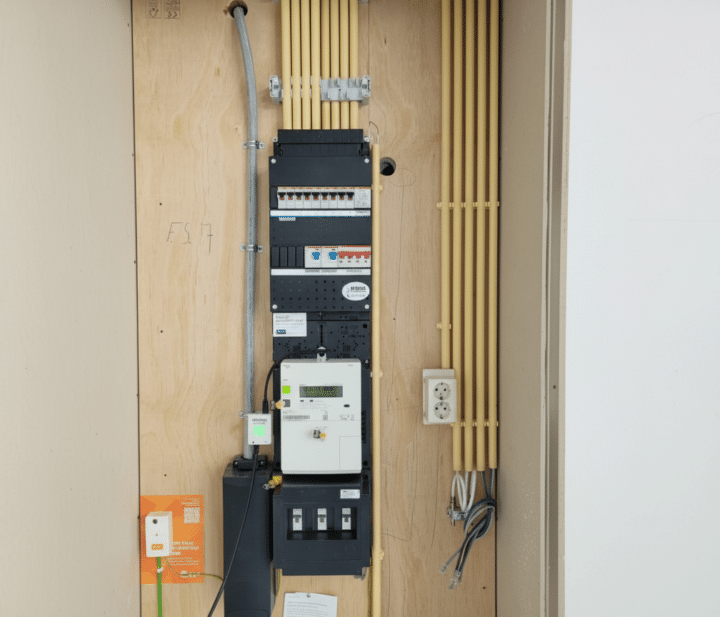
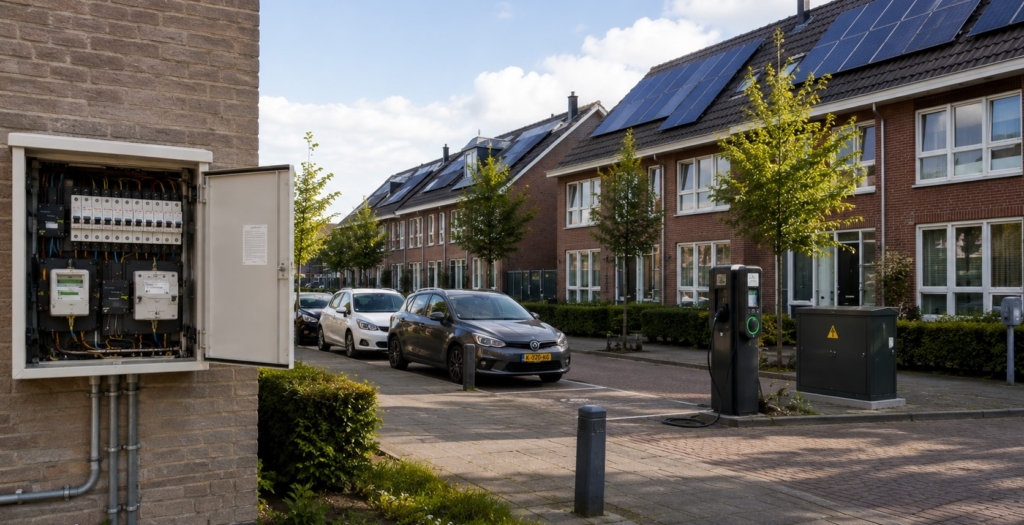
At the same time, a new tension is emerging in practice. Modern PV installations are increasingly integrated with battery storage, energy management systems, collective residential installations and EV charging infrastructure. This drives the need for more metering points, while the available physical space in distribution cabinets is actually shrinking. It is precisely at this point that the need arises for a more compact approach to gross production metering.
The Problem with Traditional Gross Production Meters
Conventional gross production meters are designed from a classical metering architecture. The meter is placed as a separate registration layer between the generation installation and the grid connection, often combined with additional communication hardware for data transport to the backend, metering company or energy management platform.
In theory, this works perfectly well in terms of regulatory compliance. In practice, however, this setup increasingly creates physical and technical limitations. Many modern installations are located in places where every DIN module counts — compact technical rooms in commercial buildings, integrated PV distribution boards, collective installations within homeowners associations, or technical infrastructure around charging plazas and battery setups.
For installers, this often means a difficult design choice. Metering obligations for subsidy settlement must be met, while the available space does not allow for a traditional meter setup. Added to this is the fact that extra gateway hardware not only requires more space, but also adds extra configuration, cabling and management overhead.
This is precisely the problem that CompactIQ was developed to solve
Want to know more about the CompactIQ and how your business can profit from it? Learn more about the CompactIQ >>
Why CompactIQ Makes the Difference in Subsidy-Driven PV Projects
CompactIQ is designed around two practical questions that are increasingly converging. For small commercial installations (up to 3×80 A): how do you realise compact, reliable production data as input for battery and EMS control at locations where a traditional meter physically does not fit? For large commercial SDE++ projects (> 3×80 A): how do you consolidate the data from multiple sub-meters into one compact gateway, without adding extra communication hardware to the cabinet?
The answer differs by situation. On low-volume connections (up to 3×80 A), CompactIQ combines certified grid metering and gateway functionality in one compact housing — a complete metering and communication module for EMS integration in a single DIN module. On high-volume connections, CompactIQ acts as a compact Modbus gateway: it reads existing sub-meters and bundles the data into a single communication point, without requiring additional gateway hardware in the cabinet.
This makes CompactIQ relevant for both scenarios. In small commercial PV installations, it provides a compact metering and communication module that makes production data directly available for battery and EMS control. In SDE++ projects on high-volume connections, it eliminates the separate gateway hardware behind the sub-meters. In both cases, the metering layer can be directly integrated into the existing distribution board, without cabinet expansion.
Want to know more about the CompactIQ and how your business can profit from it? Learn more about the CompactIQ >>
Especially for installers working on commercial solar rooftops, battery integrations and collective energy installations, this offers a major practical advantage. The installation remains compact, the metering structure meets the required production registration, and the metering data is made available multiple times per day to the backend or energy management system — without the installer having to build a separate communication chain.
From Subsidy Obligation to Periodic Energy Insight
Where gross production metering was traditionally seen primarily as an administrative precondition for subsidy processing, that role is changing. In modern energy architectures, production data is a valuable input source for energy management systems that optimise based on generation, consumption and tariffs.
This is especially true in installations where PV generation is linked to battery storage, dynamic energy tariffs or smart charging. An energy management system operates on the basis of real-time production data — and that data must be reliable, certified and available without manual management.
CompactIQ enables this step because the meter not only registers, but also periodically exposes metering data to external systems. This transforms gross production metering from a passive registration layer into a usable data source for energy optimisation — without the installer having to set up a separate communication stack.
For EMS installers, this means reliable metering data as input for control algorithms, without extra hardware. For asset owners, it means better insight into locally generated energy and the generation-to-self-consumption ratio. For subsidy projects, it means a metering architecture that meets regulatory requirements while simultaneously adding operational value by feeding the same data to the EMS
Integration with EV Charging Infrastructure and Collective Energy Systems
This development now touches far more than just traditional PV projects. In charging plazas, car parks and commercial energy hubs, solar generation is increasingly coupled directly to charging infrastructure. The same need for compact, accurate metering points arises there.
CompactIQ was originally developed for unmanned locations such as public charging points and roadside infrastructure, where space is limited and traditional smart meters are practically not applicable. Those same characteristics make the system particularly suitable for gross production metering within compact PV installations.
For EV installers and CPOs, this means that local solar generation becomes directly visible for load balancing and energy distribution. For residential development projects and homeowners associations, it offers a scalable way to transparently record production, consumption and allocation without extensive expansions of the technical infrastructure.
The New Standard for Compact Gross Production Metering
The energy transition calls for a different way of thinking about metering. Where the traditional gross production meter was primarily a mandatory metering point for subsidy control, the need is growing for metering solutions that do more: integrate compactly, periodically expose data and feed the energy management system with reliable production figures.
That is precisely where CompactIQ distinguishes itself.
On low-volume connections, CompactIQ combines certified metering and communication in one compact unit — the complete metering and communication module for EMS integration without extra hardware. On high-volume connections, it bundles sub-meter data into one communication point as a Modbus gateway. In both cases, the solution fits in existing distribution boards without cabinet expansion, and delivers metering data that contributes to both subsidy compliance and operational optimisation.
Conclusion
For many PV projects, gross production metering starts from a regulatory perspective. Without correct registration there is no validated production, and without validated production there is no correct subsidy payment.
But practice shows that this mandatory metering layer can mean much more. When gross production metering is configured compactly and communicatively — as an EMS data source for low-volume connections, as a compact gateway for high-volume connections — the result is not only compliance, but also periodic energy insight that supports self-consumption optimisation and EMS integration.
CompactIQ makes exactly that step possible. It offers PV and EMS installers a compact metering and communication solution that meets the requirements for gross production metering — whether as an EMS data source for low-volume connections or as a gateway for high-volume connections — while the same infrastructure exposes metering data for energy management, self-consumption optimisation and EMS integration.
That makes CompactIQ not only a practical solution for today, but a metering architecture for the next phase of the energy transition
Frequently Asked Questions about Gross Production Metering and Energy Management
What is gross production metering for solar panels?
Gross production metering records all electricity generated by a PV installation. The measurement takes place before the generated energy is consumed locally or fed back to the grid. This provides a complete and reliable picture of total solar production.
When is gross production metering required?
For many commercial solar energy projects using SDE++ subsidies, gross production metering is a condition for subsidy payment. Generated energy must be demonstrably and verifiably recorded in accordance with applicable requirements.
Why is gross production metering becoming more important after 2027?
With the abolition of the net-metering scheme, the focus shifts from feed-in to maximum self-consumption. Reliable production data helps energy management systems to control batteries, charging points and other energy consumers more intelligently.
Can gross production metering be used for EMS integration?
Yes. Modern energy management systems use production data as a key input for energy optimisation. Based on this data, the system can for example charge batteries, control charging points or shift energy consumption to periods of high solar generation.
What are the benefits of real-time production data?
Real-time insight makes it possible to respond faster to changes in production and consumption. This supports load balancing, battery control, smart charging of electric vehicles and a higher degree of energy self-sufficiency.
How does gross production metering support battery storage?
By providing continuous insight into current solar production, an EMS can determine when a battery should charge or discharge. This increases self-consumption and reduces dependence on the electricity grid.
What role does gross production metering play in EV charging infrastructure?
At charging plazas and commercial charging locations, production data shows how much locally generated solar energy is available. This allows charging points to be controlled more efficiently and locally generated energy to be used optimally.
Why is there a space shortage in modern distribution cabinets?
Modern installations increasingly combine solar panels, batteries, charging points, energy management and monitoring. As a result, the number of components increases while the available space in technical installations remains limited.
What is the difference between low-volume and high-volume connections?
In the Netherlands, a connection up to and including 3×80 A is classified as low-volume. Connections above 3×80 A fall under high-volume. Requirements for metering, communication and subsidies may therefore differ.
Why are installers looking for more compact metering solutions?
Compact metering solutions save space in distribution cabinets, simplify installation and reduce the amount of additional communication hardware required. This keeps installations more manageable and easier to maintain.
What makes CompactIQ suitable for gross production metering?
CompactIQ combines accurate energy metering and communication in a compact solution. As a result, production data is not only recorded but also automatically made available for monitoring, energy management and reporting.
Can CompactIQ be used within SDE++ projects?
Yes. On high-volume connections, CompactIQ can read and consolidate data from existing gross production meters. This creates a single central communication point for reporting and data exchange.
Does CompactIQ support energy management systems (EMS)?
Yes. CompactIQ delivers reliable production data that can be used directly by energy management systems for energy optimisation, load balancing, battery control and smart charging.
How does CompactIQ help with battery control?
By making real-time production data available, an EMS can determine when energy should be stored or used. This increases self-consumption of locally generated solar energy.
Can CompactIQ be deployed at charging plazas and energy hubs?
Yes. CompactIQ was developed for locations where space is limited, such as public charging points and roadside infrastructure. This makes the solution an excellent fit for charging plazas, energy hubs and collective energy systems.
Does CompactIQ fit in existing distribution cabinets?
CompactIQ is designed for compact installations where every DIN module counts. The solution can therefore often be integrated without extensive modifications to existing distribution boards.
Does CompactIQ support Modbus communication?
Yes. CompactIQ supports Modbus communication and can act as a compact gateway on high-volume connections for reading and consolidating data from multiple meters.
How does CompactIQ support self-consumption optimisation?
By making production data available to EMS platforms, insight is created into generation, consumption and storage. This allows locally generated energy to be used more efficiently and increases self-consumption.
Place a Request for a CompactIQ
Are you looking for a compact solution for gross production metering, EMS integration or unlocking energy data within a PV installation? CompactIQ provides reliable metering data for energy management, battery control, charging infrastructure and subsidy-related applications.
Fill in the form and receive a no-obligation proposal based on your situation. Our specialists are happy to assess which configuration best fits your installation, connection type and energy management requirements.
Burgemeester Burgerslaan 40
5245 NH ’s-Hertogenbosch, Nederland
Metropoolstraat 11a
2900 Schoten; België

"*" indicates required fields