Load balancing for your EV charger: how dynamic load balancing works

In this article, you’ll learn how load balancing works, when you need it, and the difference between measuring via the smart meter’s P1 port and via CT clamps. You’ll also see how it works with solar panels, a 3-phase connection and multiple charge points.
What is load balancing for an EV charger?
Load balancing distributes the available capacity of your grid connection between your EV charger and the rest of your home or building. A meter continuously tracks how much power is already being used. The charger only gets what is left.
Example: you have a single-phase 35A connection, good for about 8 kW. Your charger can deliver 32A (7.4 kW). Switch on the dishwasher and the oven, and there is not enough left for full-speed charging. Without load balancing, the main fuse trips. With load balancing, the charging current temporarily drops to, say, 10A, then goes back up.
Static vs. dynamic load balancing
There are two types:
- Static load balancing sets a fixed maximum charging current, for example 16A. It’s simple, but you also charge slowly when there is plenty of capacity.
- Dynamic load balancing adjusts the charging current every few seconds to match actual consumption. You charge as fast as possible and as slowly as necessary.
In almost every situation, dynamic load balancing is the better choice. That is what the rest of this article covers.
Load balancing vs. smart charging
The terms are often used interchangeably. Load balancing protects your connection from overload. Smart charging goes a step further and also decides when to charge, for example on solar power or at a low dynamic electricity price. Load balancing is the foundation; smart charging builds on it.
Do you need load balancing?
In most homes with an EV charger: yes. A charger is often the biggest consumer in the house, and it typically runs in the evening, when the rest of the household also needs power. How tight it gets depends on your connection.
| Connection | Total capacity | Typical charger | Headroom while charging at full power | Advice |
|---|---|---|---|---|
| 1 × 35A | approx. 8 kW | Single-phase 32A (7.4 kW) | approx. 3A | Load balancing strongly recommended |
| 1 × 40A | approx. 9.2 kW | Single-phase 32A (7.4 kW) | approx. 8A | Load balancing strongly recommended |
| 3 × 25A | approx. 17 kW | 3-phase 16A (11 kW) | 9A per phase | Recommended with a heat pump or induction hob |
| 3 × 35A | approx. 24 kW | 3-phase 32A (22 kW) | 3A per phase | Load balancing strongly recommended |
Indicative values based on 230/400V. Your installer determines what is safe and sensible in your situation.
Load balancing is almost always needed if you:
- have a single-phase connection;
- use a heat pump, induction hob, electric boiler or air conditioning;
- want to charge two cars or use multiple charge points;
- have solar panels and want to charge on your own solar power;
- want to avoid an expensive grid connection upgrade.
It is less necessary if you have a generous 3-phase connection, few other large consumers and mostly charge at night. Even then, load balancing offers peace of mind, because your consumption often changes faster than you think.

How does load balancing work: P1 port or CT clamps?
For dynamic load balancing, the charger needs to know how much power the rest of the building is using. That measurement comes from the smart meter (via its P1 port, the customer data port on Dutch and Belgian smart meters) or from current clamps in the meter cupboard.
- Measure: the smart meter or the clamps measure total consumption per phase.
- Transmit: a dongle or converter translates that measurement into a signal the charger understands, such as Modbus TCP.
- Calculate: the charger works out how much capacity is still free before the connection’s maximum is reached.
- Adjust: the charging current automatically goes up or down, to a minimum of 6A. If less than 6A is available, charging pauses.
P1 port vs. CT clamps
| Via the P1 port | Via CT clamps | |
|---|---|---|
| What you need | Smart meter + P1 dongle | Current clamps + converter in the meter cupboard |
| Installation | Plug into the smart meter | Clamps around the main cables, fitted by an installer |
| Measurement interval | Every second (DSMR 5.0) or every 10 seconds (DSMR 4.2) | Continuous, near-instant |
| Solar feed-in | Yes, the meter sees the net flow | Yes, if positioned correctly |
| Suitable for | Homes and small commercial buildings with a smart meter | Buildings without an (accessible) smart meter, submetering, larger installations |
In most homes, the P1 port is the simplest and most affordable route: the smart meter already measures everything needed. Without a smart meter, or if the P1 port is unavailable, CT clamps are the alternative. For that, Xemex offers the CSMB current converter.
Load balancing with solar panels
With solar panels, load balancing becomes even more valuable. Because the smart meter also sees how much you feed back into the grid, the charger can put that surplus straight into your car. Many chargers offer charging modes such as:
- Solar only: charging starts once there is enough surplus and follows solar production.
- Solar + grid: charging at a minimum current, topped up with solar power when available.
- Fast charging: as fast as the connection allows, within the limits of load balancing.
This is becoming increasingly important. In the Netherlands, the net metering scheme (salderingsregeling) ends on 1 January 2027, making feed-in far less profitable. Every kWh you charge into your own car is a kWh you don’t have to buy back later at a higher price. Read more about optimising self-consumption.
Which charging modes are available depends on the charger. The dongle supplies the measurement data; the charger determines the strategy.
Load balancing with a 3-phase connection
Load balancing is also sensible with a 3-phase connection, because the fuse protects each phase separately. A 3 × 25A connection therefore doesn’t have 75A to distribute freely, but 25A per phase. That is where the risk lies: a 3-phase charger draws equally from all three phases, while your hob, washing machine or heat pump often runs on just one or two. That one phase fills up first.
Good dynamic load balancing therefore measures per phase and matches the charging current to the most heavily loaded phase. A smart meter with a P1 port provides that per-phase measurement as standard.
Example: a home with 3 × 25A, an 11 kW charger and a heat pump on phase 1. When the heat pump starts, the charger sees that phase 1 is reaching its limit and lowers the charging current from 16A to, say, 10A. When the heat pump stops, the charging current returns to 16A.
Multiple charge points and grid congestion
Companies, apartment buildings and car parks often have several charge points on a single connection. Load balancing then distributes the available capacity across all cars charging at that moment. When another car plugs in, everyone gets a little less. When one leaves, the others charge faster.
This is especially relevant in the Netherlands because of grid congestion: in many regions, a heavier connection is unavailable or only available after years of waiting. Load balancing lets you get the most out of the connection you already have.
In Flanders, the capacity tariff plays a role: part of your grid fee is based on your highest monthly peak. By smoothing out charging peaks, you keep that peak, and your grid tariff, lower.
For larger charging sites or buildings with several large consumers (battery, heat pump, PV), an energy management system such as ENNY-EMS is the logical next step. It controls not just chargers, but all flexible loads together.
Load balancing with the Xemex Smart Connect P1
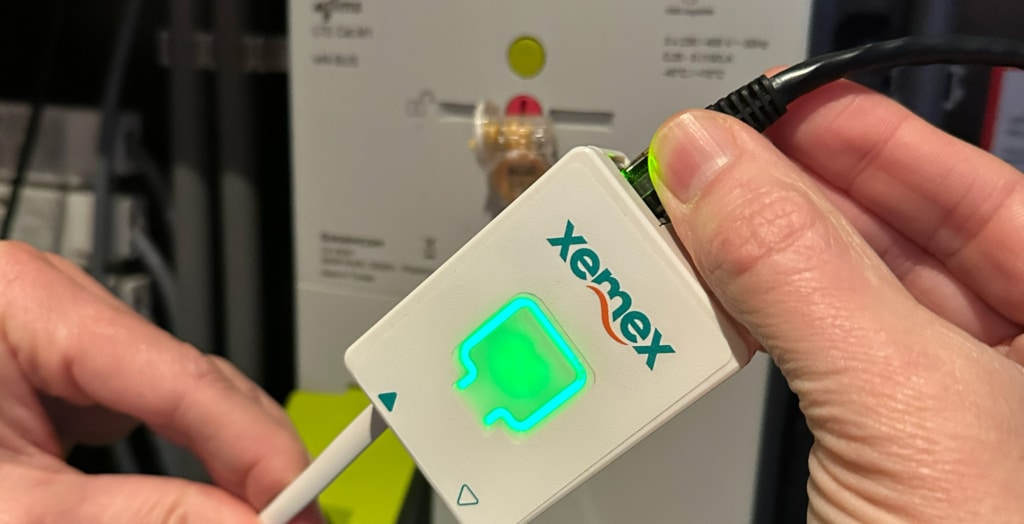
The Xemex Smart Connect P1 is a compact P1 dongle that passes real-time measurement data from the smart meter to your EV charger. The charger uses that data for dynamic load balancing and solar charging. The dongle is developed and manufactured in the Netherlands.
How it works
The Smart Connect P1 reads the P1 telegram from the smart meter and converts it to Modbus TCP, a protocol many chargers understand natively. With a DSMR 5.0 meter, the charger receives new data every second; with DSMR 4.2, every 10 seconds.
Compatible chargers
The Smart Connect P1 works directly with chargers from brands including Peblar, Alfen, Schneider and Mennekes.
What sets the Smart Connect P1 apart
- Works with tricky meters: compatible with Sagemcom meters (S211, T211, XS212, XT211) and the Landis+Gyr E350, without an additional power supply.
- Flexible connectivity: via a network cable (Ethernet), Wi-Fi or a direct peer-to-peer connection with the charger.
- Splitter function: the P1 output lets you connect an existing P1 dongle or energy monitor at the same time. No need to choose between insight and smart charging.
- More than charging: the same data can also feed home batteries, micro-inverters, an EMS or a home automation system, via Modbus TCP or MQTT.
- Netherlands and Belgium: supports DSMR 4.2 and 5.0 (NL) and E-MUCS (BE), for single-phase and 3-phase meters.
Who is it for?
For homeowners, installation is carried out by an installer. Check our partner locations to find an installer near you. Are you an installer or charger supplier? Read on.
For installers: load balancing sorted in a single visit
For installers, what matters most is that load balancing works quickly and without surprises. The Smart Connect P1 is designed for exactly that:
- Quick to install: plug into the P1 port, connect to the charger and configure via the built-in web interface, accessible via mDNS, the local IP address or the dongle’s own Wi-Fi hotspot.
- No network hassle: with a peer-to-peer connection, you link the dongle directly to the charger, independent of the customer’s home network.
- Existing dongle keeps working: does your customer already have a P1 dongle for energy insight? Connect it to the P1 output.
- Power supply: with DSMR 5.0, the dongle is powered via the P1 port. With DSMR 4.2, or when using the P1 output, connect a USB-C power supply.
The manual, product sheet and declaration of conformity are available on the Smart Connect P1 product page.
Want to use the Smart Connect P1 in your installations? Contact our sales team for pricing, project support or a trial unit.
Frequently asked questions about load balancing
What is dynamic load balancing?
Dynamic load balancing continuously adjusts your EV charger’s charging current to the actual power consumption in your home or building. You charge as fast as your connection allows, without tripping the main fuse.
Does every EV charger have load balancing?
Many modern chargers support load balancing, but they need an external measurement to do so: a P1 dongle or current clamps. Without that measurement, the charger doesn’t know how much power the rest of the house is using.
Which chargers work with the Smart Connect P1?
The Smart Connect P1 works directly with chargers from brands including Peblar, Alfen, Schneider and Mennekes. Not sure about another brand? Contact us.
Does load balancing work with every smart meter?
The Smart Connect P1 supports DSMR 4.2 and 5.0 in the Netherlands and E-MUCS in Belgium. Sagemcom meters and the Landis+Gyr E350 also work, without an additional power supply.
Can I keep using my existing P1 dongle?
Yes. Via the Smart Connect P1’s P1 output, you connect a second dongle or energy monitor. Both receive the same data.
Is load balancing needed with a 3-phase connection?
Often, yes. The fuse protects each phase separately, and other large consumers usually load only one phase. Per-phase load balancing prevents that phase from being overloaded.
Does load balancing work with solar panels and a dynamic energy contract?
Yes. The smart meter also sees your feed-in, so the charger can charge on solar power. Whether it also responds to dynamic tariffs depends on the charger or the energy management system.
What is the difference with smart charging?
Load balancing protects your connection from overload. Smart charging also determines when you charge, for example on solar power or at a low electricity price.
Always ready to start
Wondering what we can do for your organization? Contact Xemex and discuss your needs with our team. Together we will realize a solution that addresses your energy challenges and opens up new possibilities.
Burgemeester Burgerslaan 40
5245 NH 's-Hertogenbosch, The Netherlands
Metropoolstraat 11a
2900 Schoten; Belgium