Compact Metering in EV Infrastructure: The Invisible Layer That Makes Charging Systems Scalable
In the world of electric mobility, a quiet shift is taking place. While the number of charging points in car parks, on business estates and along public infrastructure is growing exponentially, the underlying metering architecture often remains based on a design that has not kept pace with today’s reality.
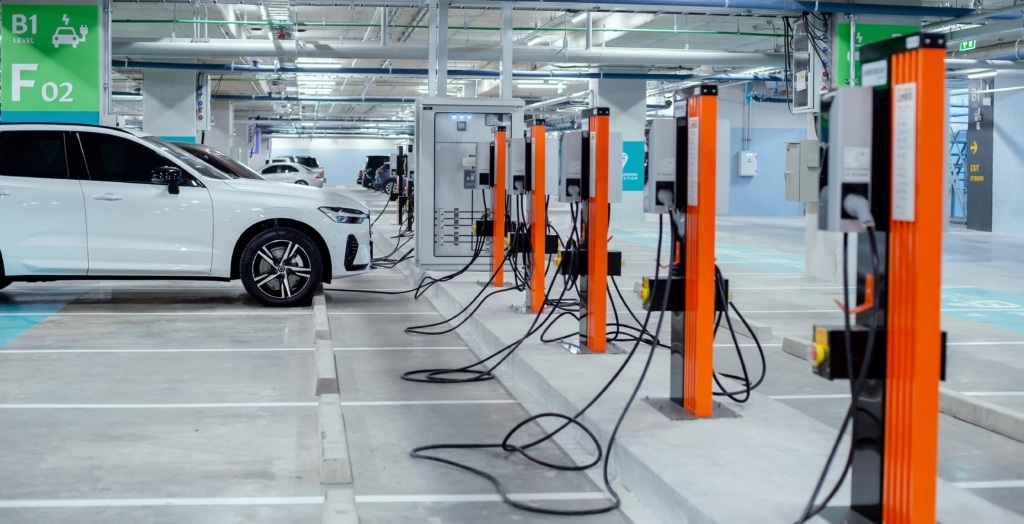
The core of the problem does not lie with the charging technology itself. Modern AC and DC chargers are technically mature, communicatively connected and prepared for dynamic load balancing. The limitation lies in something more fundamental: the ability to measure what is actually happening in the installation at the right level of detail.
Where installations could previously make do with a single smart meter on the main connection, that approach is functionally outdated in complex EV environments. Energy flows are no longer linear, but distributed, fluctuating and dependent on the simultaneous behaviour of tens to hundreds of charging points.
From Central Metering to Local Observation
In traditional electrical installations, the smart meter functions as the central source of truth. All energy is measured at a single point and from there aggregated for billing, monitoring and, where applicable, load management. In EV charging infrastructure, however, a different dynamic emerges. Energy consumption is no longer determined by a single large consumption point, but by a network of parallel charging sessions, each with its own power profile and time variation.
This makes central metering insufficient for operational control. Load balancing systems can only be effective when they have access to current and detailed information per charging point or per subgroup within the installation. In practice, this means the metering layer must move closer to the physical load — not as an additional layer, but as an integral part of the electrical infrastructure itself.
The Technical Constraint of Space and Integration
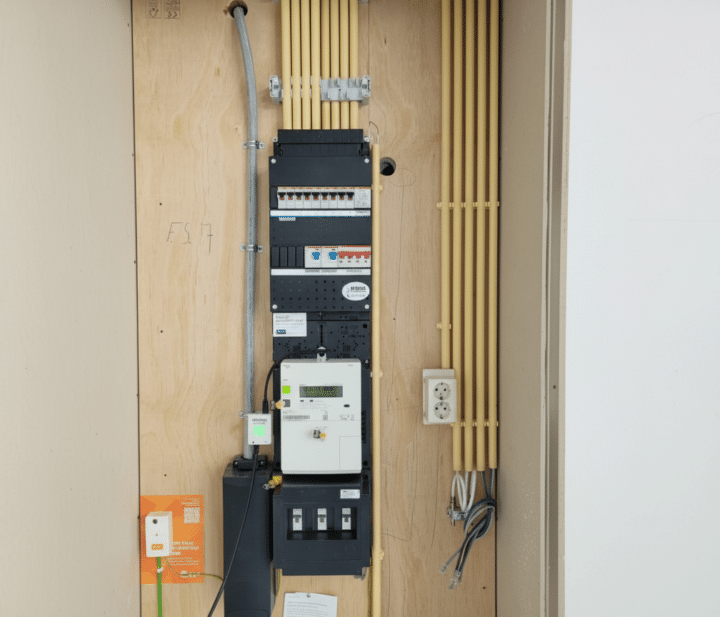
In many EV projects — particularly in existing car parks and urban infrastructures — space in distribution cabinets is a critical factor. Installers are confronted with compact switchboards in which every additional component leads to mechanical constraints, thermal challenges or installation redesigns.
Traditional smart meters or sub-metering solutions are often designed as separate components with their own housing, communication gateway and mounting requirements. That model works in new utility buildings, but not in retrofit environments or large-scale charging plazas where hundreds of connection points are added to existing infrastructure.
A second constraint also applies: the separation between metering and communication. In many architectures, the meter is merely a data supplier, while a separate gateway is responsible for data transport to EMS or CPO platforms. This not only increases complexity, but also the risk of latency and integration issues.
CompactIQ as an Integrated Metering and Gateway Layer
Within this context, CompactIQ positions itself as a fundamentally different approach to energy infrastructure. The system combines metrology and gateway functionality in a single compact DIN-rail format and has been specifically developed for environments where conventional smart meters are physically or technically not applicable.
The core of this approach lies in integration. By combining metering and communication in a single device, the need for separate component layers within the distribution board disappears. This makes it possible to place metering points in locations where traditional meters simply do not fit — such as compact EV charging distribution boards, street cabinets or distribution systems in car parks.
The primary application is in unmanned infrastructure, such as public charging points and EV charging plazas, where continuous energy metering is essential for monitoring, billing and load management. At the same time, CompactIQ functions as a sub-meter in more complex energy environments where multiple energy sources converge.
EV Charging Plazas as Distributed Energy Networks
In modern charging plazas, the electrical infrastructure is no longer a passive distribution of energy, but an actively controlled system in which multiple charging points operate simultaneously within a limited connection capacity. This creates a situation in which the network constantly balances available capacity against actual demand. Without detailed metering at charging point level, this balance is based on assumptions rather than real-time data.
CompactIQ changes this dynamic by making metering data available via Modbus directly at the level where energy is actually consumed. This gives EMS and CPO platforms real-time visibility of individual charging currents and phase imbalance within the installation — even when a separate grid measurement via the main connection is absent.
In car parks, where tens to hundreds of vehicles charge simultaneously, this sub-metering forms the data foundation for monitoring, billing and detecting deviations in the consumption pattern per charging point.
The Role within EMS Architectures and Grid Intelligence
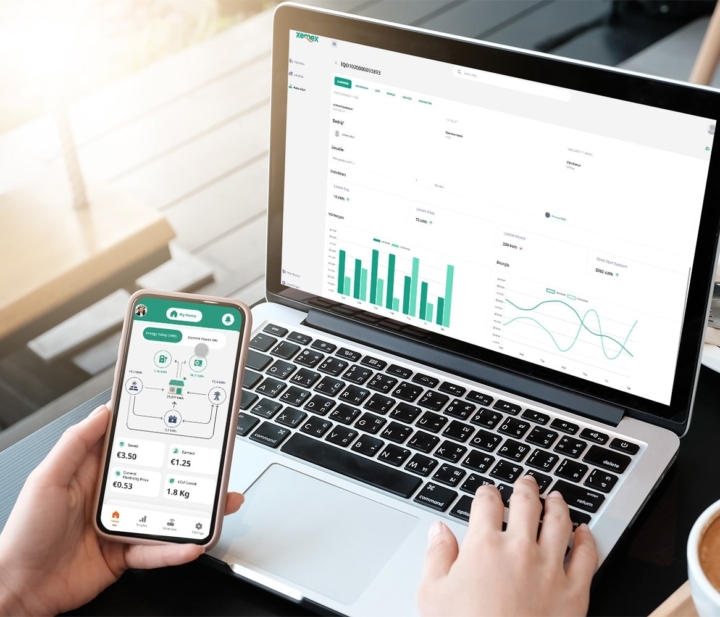
In modern Energy Management Systems, data quality plays a decisive role. EMS platforms not only control consumption, but also combine generation from PV installations, grid import, battery storage and EV load into one integrated model.
The effectiveness of these systems is directly linked to the resolution of the metering layer. When metering data is only available at main connection level, the system is forced to work with estimates and aggregated values.
CompactIQ adds a fine-grained metering structure to this, providing EMS systems with real-time, locally measured data per consumption node. This not only enables more accurate control, but also increases the reliability of predictive algorithms within load balancing and energy management.
Application Beyond EV: Residential Construction and PV Integration
Although the direct application is visible in EV infrastructure, the relevance of compact metering extends to broader energy environments.
In residential construction projects with integrated PV installations and shared grid connections, the same challenge arises: multiple energy sources and consumers share a limited connection capacity. Without detailed metering, the system remains dependent on central assumptions rather than local reality.
In combination with solar panels and heat pumps, this challenge becomes even more complex, as both production and consumption fluctuate significantly. Compact metering makes it possible to make these interactions visible at the level of the installation itself, so that energy flows are not only measured but also understood.
A concrete application of this is solar charging. Via the Modbus interface, CompactIQ can read real-time production data from a PV inverter and pass these values directly to a charging point. Based on this, the charging point can align its charging power with current solar generation, so that the vehicle charges as much as possible on locally generated energy. This creates a direct link between generation and EV load without requiring a separate grid measurement or main meter interface.
For a CPO, this also opens new possibilities around commercial home charging. The Modbus measurement makes it possible to separately record and separate the energy flowing to a company lease vehicle from other household consumption. At the same time, the contribution of local PV generation to a charging session can be recorded, so that self-generated solar energy and grid electricity can be settled separately within the commercial reimbursement structure.
Towards a New Standard for Metering Architecture
The evolution of EV charging infrastructure shows a clear trend: energy management is shifting from central control to distributed observation.
In that model, the metering layer is no longer a supporting element, but a fundamental building block of the system. Without detailed, real-time data at installation level, scalable charging infrastructure is no longer technically viable.
CompactIQ fits within this shift as an infrastructure component that bridges the gap between physical energy distribution and digital control — not by adding complexity, but by condensing the metering architecture into a form that fits the physical reality of modern installations.
Conclusion: The Future of Charging Is Determined by What You Cannot See
The greatest challenge in EV infrastructure is not delivering more power, but understanding how that power behaves within increasingly complex networks.
Without compact, integrated metering, that behaviour remains largely invisible. And what is not visible cannot be controlled, optimised or scaled.
CompactIQ introduces a metering layer in this landscape that is not placed on top of the infrastructure, but becomes part of it. This shifts the focus from reactive control to real-time insight, and from global assumptions to local precision.
In an energy grid that increasingly resembles a distributed data network, that is precisely what makes the difference between limitation and scalability.
Place a Request for Compact Metering in EV Charging Infrastructure
Are you looking for a compact metering solution for your EV charging plaza, car park or energy hub? CompactIQ combines energy metering and gateway functionality in a single compact format — suitable for load balancing, EMS integration, billing and solar charging without additional hardware in the cabinet.
Fill in the form and receive a no-obligation proposal based on your situation. Our specialists are happy to assess which configuration best fits your charging infrastructure, connection type and energy management requirements.
Burgemeester Burgerslaan 40
5245 NH ’s-Hertogenbosch, Nederland
Metropoolstraat 11a
2900 Schoten, België

"*" indicates required fields